Find Parts that fit Your Car
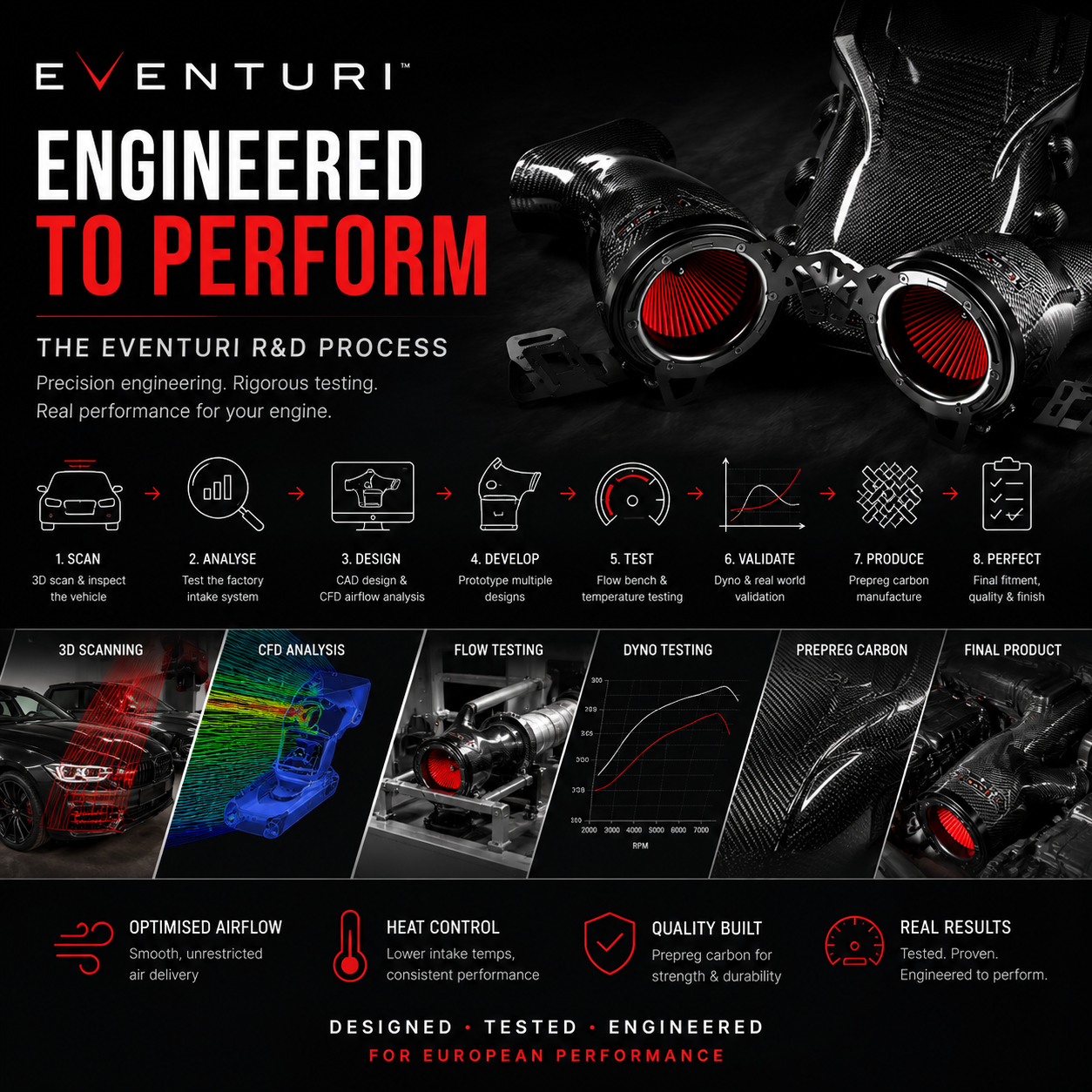
Eventuri intake systems are easy to recognise by their carbon fibre construction, but the appearance is only the visible result of a much deeper development process. Each system starts with a specific vehicle, its available engine-bay space, its original air path and the demands placed on the engine or turbocharger.
Eventuri combines 3D scanning, CAD design, computational fluid dynamics, prototype testing, airflow measurement, intake-temperature logging, dynamometer testing and real-world validation before a system reaches production. The objective is not simply to fit a larger filter. It is to create a complete intake path that can move air efficiently, control heat and integrate properly with the vehicle.
Explore Eventuri Carbon Intakes Shop Eventuri Intake Systems
Why Intake Development Is More Complicated Than It Looks
A modern intake must work within a tightly packaged engine bay while supplying enough air for the engine’s full operating range. On turbocharged vehicles, the intake also needs to feed the compressor without creating unnecessary restriction or drawing excessive heat from the engine compartment.
A poorly developed system can look impressive but still suffer from abrupt changes in cross-section, turbulent transitions, inadequate cold-air supply or heat soak. This is why Eventuri treats the filter, housing, ducts and inlet tubes as one complete system rather than a collection of unrelated parts.
The Eventuri Research and Development Process
1. Vehicle Inspection and 3D Scanning
The process begins with the actual vehicle. Eventuri examines the original airbox, intake ducts, sensors, turbo inlets, mounting points and surrounding heat sources. The available space is measured and, for many projects, the engine bay and original components are digitally scanned.
Accurate scanning allows the development team to work around factory clearances and reproduce complex mounting geometry in CAD. It also helps identify unused areas that may provide additional air volume or a second cold-air feed.
This vehicle-first approach is important because two engines with similar power outputs can require completely different solutions. One may need a sealed housing beside a hot exhaust manifold, while another may benefit most from larger frontal ducts or smoother turbo-inlet transitions.
2. Establishing a Baseline
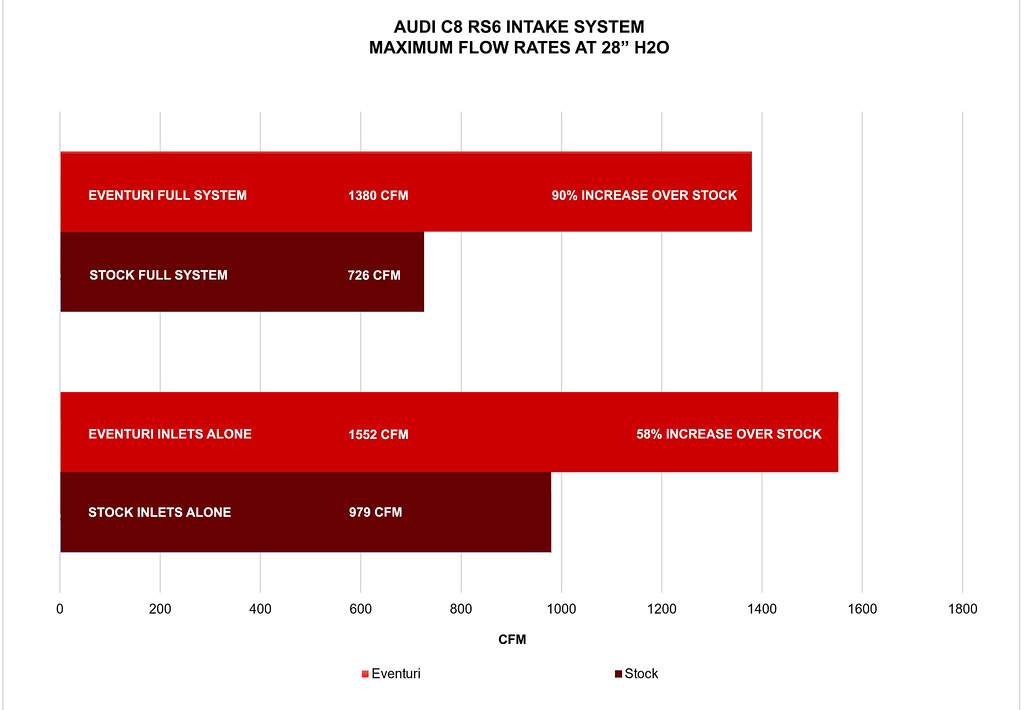
Before replacing the factory system, Eventuri studies how it behaves. The original intake provides the baseline for airflow, pressure drop, intake temperature and engine performance.
The development team looks for the areas that actually limit the system. These can include:
- a restrictive filter area;
- sharp changes in direction after the filter;
- small turbo-inlet openings;
- hot air entering from the engine bay;
- limited cold-air ducting;
- unequal airflow between two engine banks; or
- an intake volume that becomes restrictive as power increases.
This prevents the new design from solving the wrong problem. A larger pipe is not useful if the main restriction is elsewhere, and an open filter may move more air on a bench while performing poorly once exposed to engine-bay heat.
3. CAD Design and CFD Analysis
Once the original system and available space are understood, the intake is designed digitally. CAD allows the housing, ducts, filter position and inlet tubes to be developed as one continuous path.
Eventuri then uses computational fluid dynamics to examine how air is expected to move through the design. CFD can reveal high-velocity zones, recirculation, abrupt pressure changes and areas where the shape may cause unnecessary resistance.
The goal is not simply the largest possible opening. The path should transition progressively from the filter into the intake tube or turbo inlet, maintain useful internal volume and distribute airflow appropriately for the engine.
The Eventuri Filter Housing Concept
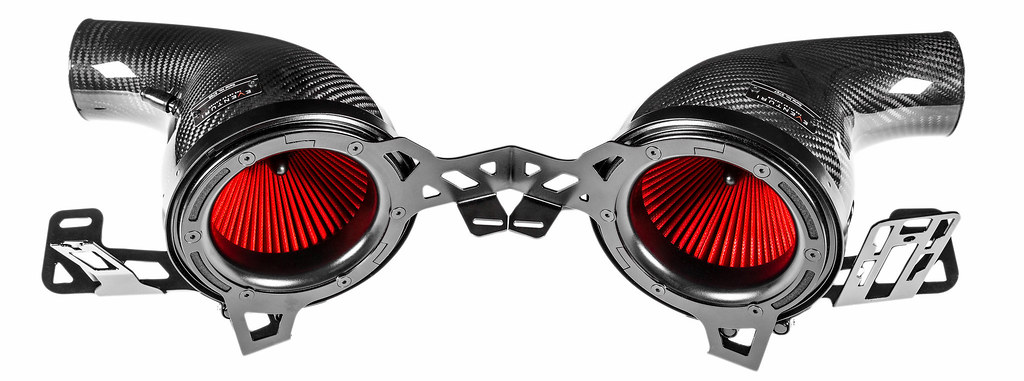
One of Eventuri’s best-known features is its carbon fibre filter housing. Rather than placing a conventional cone filter in front of a separate tube, the housing surrounds the filter and creates a shaped transition towards the outlet.
This gives the design team control over the air path immediately after the filter. The housing can expand around the filter to maximise usable surface area and then guide the filtered air towards the intake tube without an abrupt step.
The exact shape changes for every vehicle. Some systems use a single large housing, others use two mirrored housings, and some applications require a bespoke panel-filter airbox. The common principle is that the filter and outlet geometry are designed together.
4. Prototypes, Alternatives and Repeated Testing
A digital model is not treated as the finished answer. Eventuri produces prototypes, installs them in the vehicle and compares alternative configurations.
That may involve changing:
- filter dimensions and position;
- housing volume;
- inlet and outlet diameters;
- duct entry angles;
- airbox lid profiles;
- cold-air feed locations;
- heat shields and seals; or
- the balance between left and right intake paths.
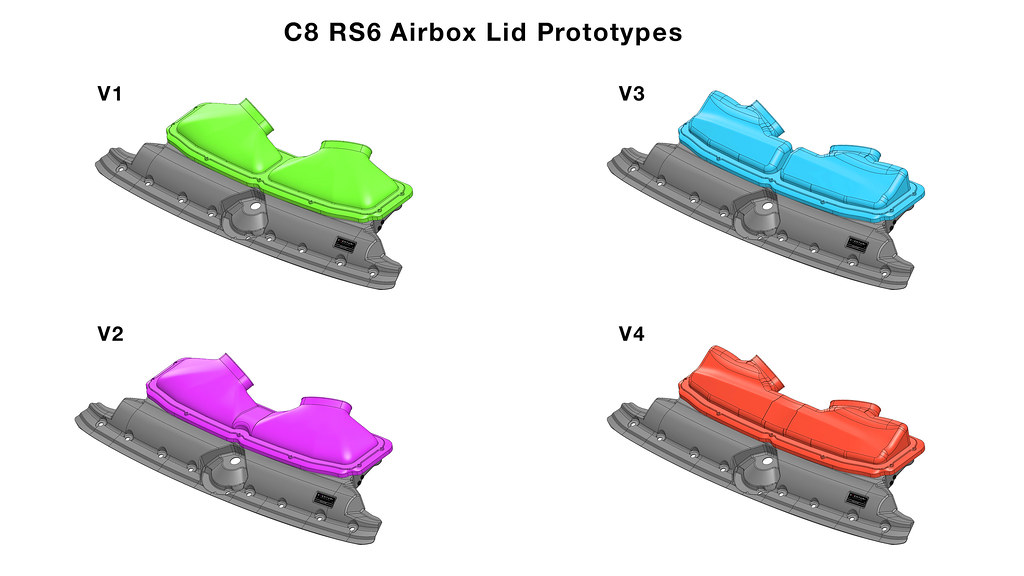
For the Audi C8 RS6 and RS7 system, Eventuri says it developed and tested four different airbox-lid designs before selecting the highest-performing version. That final design was further refined through CFD and used a smoother, larger-volume shape than the original lid.
5. Airflow and Pressure-Drop Testing
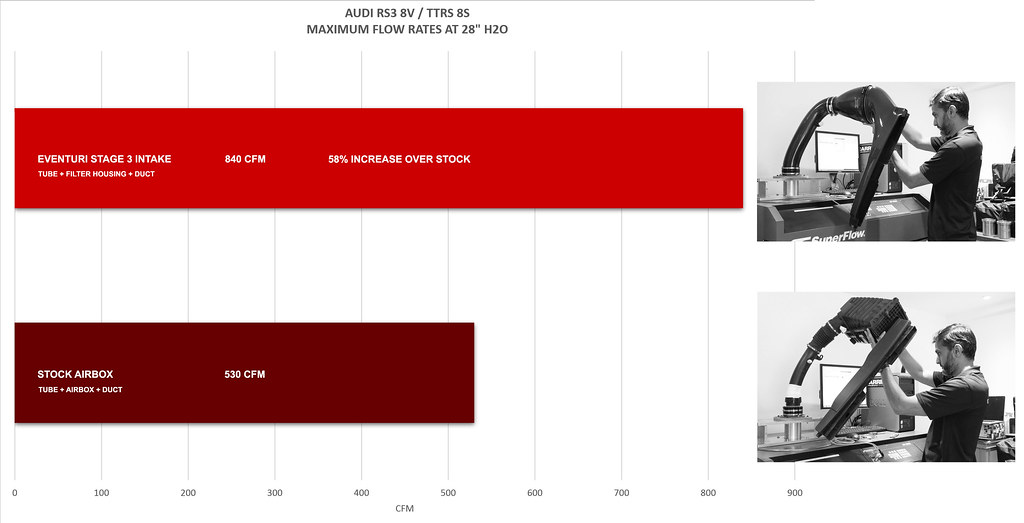
Prototype systems are checked for volumetric airflow and restriction. The testing helps determine whether the new design can move more air without creating an inefficient path or sacrificing filtration.
This is particularly important on tuned vehicles. As boost and airflow demand increase, a factory airbox that performs well at standard output can become a larger restriction. A successful upgrade should provide additional capacity without creating unstable airflow at the sensor or compressor inlet.
Eventuri sometimes works with specialist filter manufacturers to create a bespoke element where the original filter shape would limit the new design. On the C8 RS6 and RS7 system, for example, a custom BMC panel filter was developed to increase filtration area and allow a more organic airbox profile.
6. Intake-Temperature Testing and Heat Management
Airflow alone is not enough. The system must also manage the temperature of the air entering the engine.
Eventuri logs intake-air temperatures during development and tests how the system behaves when stationary, during normal driving and under repeated load. Depending on the application, the final design may use:
- a fully sealed filter housing;
- front air scoops;
- additional wheel-arch or grille feeds;
- heat shields;
- reflective barriers;
- larger internal air volume; or
- ducts positioned away from major heat sources.
For the BMW F92 M8 system, Eventuri describes using sealed housings, front scoops and shielding to maintain stable intake temperatures. For the BMW G42 M240i, an additional opening near the wheel-arch area was used to create a secondary feed into the airbox.
7. Dynamometer and Real-World Validation
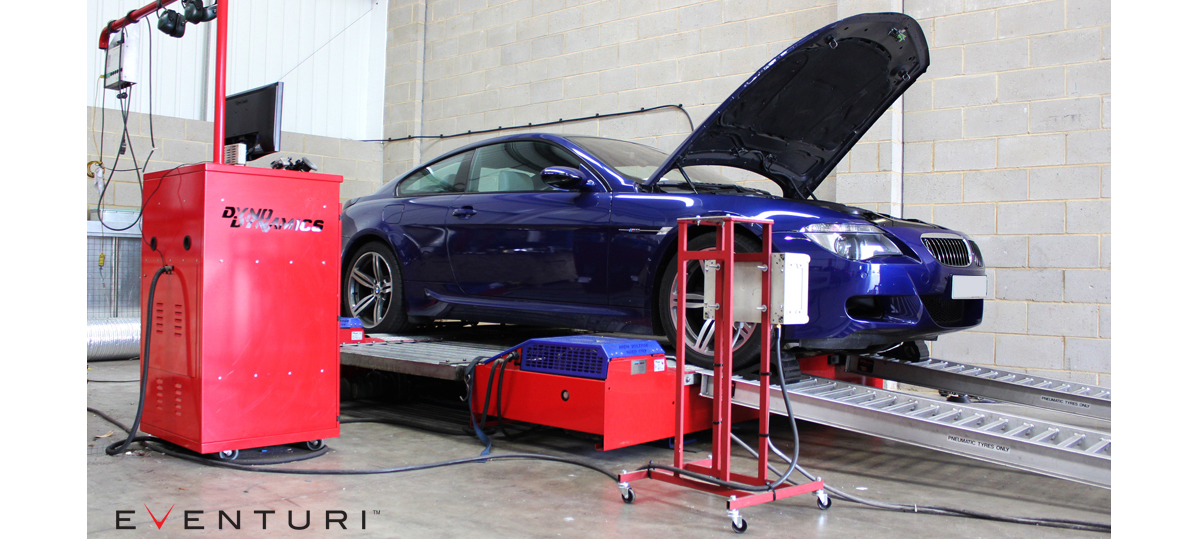
The prototype is then validated on the vehicle. Eventuri uses dynamometer testing to compare the original and revised systems and, for selected applications, also publishes road-testing results.
Good comparison testing controls as many variables as possible. That can mean using the same vehicle, the same ECU calibration, the same dyno, the same day and repeated runs before and after the intake change.
The purpose is not only to find a peak number. The team also examines the shape of the power curve, throttle response, consistency between runs and whether improvements remain present under real operating conditions.
Results remain application-specific. An intake that delivers a large improvement on a highly tuned twin-turbo engine should not be used to predict the result on a standard naturally aspirated vehicle.
8. From Prototype to Prepreg Carbon Fibre
Once the final geometry has been validated, the production components are manufactured. Eventuri uses prepreg carbon fibre for many of its housings, ducts and tubes.
Prepreg material has resin already distributed through the carbon reinforcement under controlled manufacturing conditions. It can be laid into complex moulds and cured to create rigid, lightweight components with a consistent finish.
For an intake system, carbon fibre offers more than appearance. It allows the aerodynamic housing and tube shapes developed in CAD to become finished components without relying on multiple generic bends and adaptors.
What This Research and Development Means for the Customer
A Complete System
The filter, housing, ducts, tubes and mounting hardware are developed around one another and around the intended vehicle.
Vehicle-Specific Fitment
The system is shaped for the available engine-bay space and connects to the correct factory mounting points, sensors and air feeds for the listed application.
Measured Development
Eventuri publishes unusually detailed information for many products, including development images, CFD work, temperature data, dyno results and comparisons with the original intake.
Performance Without Ignoring Heat
The development process considers both restriction and intake temperature rather than assuming that the most open filter arrangement is automatically the best.
Options for Standard and Tuned Cars
Many systems can be fitted to standard vehicles, while the additional airflow capacity may become more valuable as software, turbochargers and engine output are upgraded.
Premium Engine-Bay Finish
The carbon construction turns the tested airflow geometry into a distinctive finished product that can also transform the appearance of the engine bay.
Is an Eventuri Intake Worth It?
An Eventuri intake is most likely to appeal to an owner who values the complete package: vehicle-specific development, published testing, premium carbon construction, enhanced induction sound and additional airflow capacity.
The result will not be identical on every vehicle. On some applications the main attraction may be sharper response and sound; on others, especially tuned turbocharged platforms, the reduction in restriction can support a measurable performance improvement.
The right way to assess a system is to review the development data for the exact vehicle rather than relying on a universal horsepower claim.
Visit the Eventuri Range Shop Eventuri Intakes
Frequently Asked Questions
Does Eventuri develop every intake for a specific vehicle?
Yes. Eventuri develops its systems around defined vehicle and engine applications. The layout, housing, ducts, filter position and mounting hardware can vary significantly between products.
What is CFD and why is it used for an intake?
Computational fluid dynamics is a digital method for analysing how air is expected to move through a design. It helps identify restriction, recirculation, abrupt pressure changes and areas where the intake geometry can be improved before physical prototypes are finalised.
Does a larger intake always perform better?
No. Size is only one factor. The filter area, transitions, sensor position, available cold-air supply, housing volume and airflow path must work together. A poorly shaped large intake can still create turbulence, heat soak or unstable airflow.
Why does Eventuri test intake temperature?
Hotter air is less dense and can work against the benefit of reduced restriction. Intake-temperature testing shows whether the housing, seals, scoops and ducts are supplying cooler ambient air or allowing excessive engine-bay heat into the system.
Does an Eventuri intake require ECU tuning?
Not in every case. Many Eventuri systems can be installed on standard vehicles. Tuning may allow a higher-output vehicle to make greater use of the added airflow capacity, but the requirements should be checked for the exact product and vehicle.
Do all Eventuri systems use the same patented housing?
No. The housing principle appears across many products, but Eventuri also develops bespoke panel-filter airboxes, dual housings, intake plenums, scoops and other layouts where the vehicle requires a different solution.
Are published power gains the same for every vehicle?
No. Results depend on the exact engine, original intake, ECU calibration, other modifications, fuel, weather and test method. Use only the development information published for the relevant application.
How do I find the correct Eventuri system?
Use the Euro Car Upgrades Vehicle Finder and then confirm the exact engine, generation, production year and product contents. Similar model names can use different sensors, turbo inlets and engine-bay layouts.
Explore Eventuri Carbon Intake Systems
Euro Car Upgrades offers a selected range of Eventuri intake systems, filters, ducts, turbo inlets and carbon engine covers for compatible European performance vehicles.