Find Parts that fit Your Car
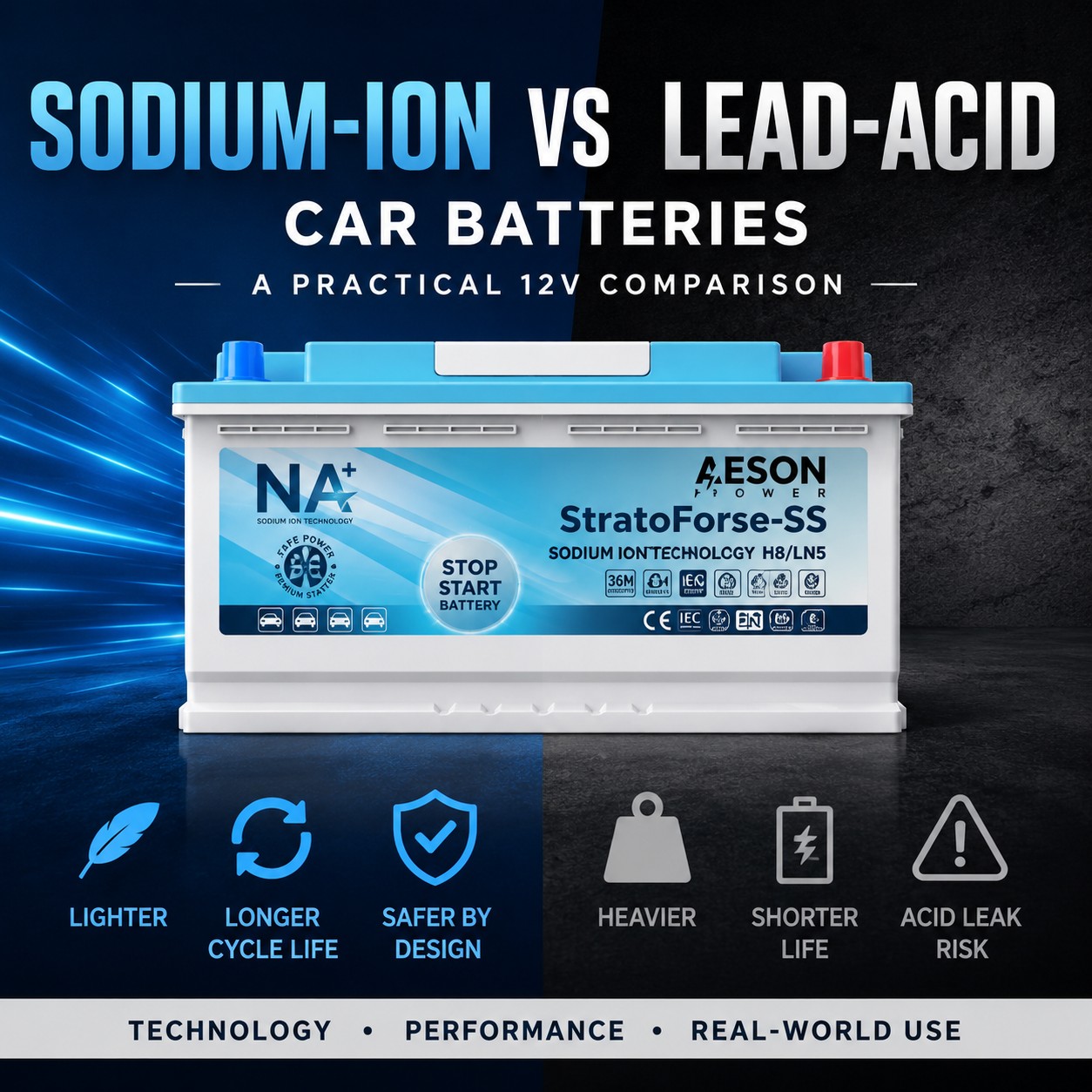
Sodium-Ion vs Lead-Acid Car Batteries: A Practical 12V Comparison
Lead-acid batteries have powered vehicle starting systems for generations. They are inexpensive, proven, widely available and very good at delivering the short burst of high current required to crank an engine.
Sodium-ion is a much newer option, but it is no longer just a laboratory technology. Automotive sodium-ion batteries are now being sold as direct 12V starter replacements, with major advantages in weight, cycle life, deep-discharge tolerance and storage performance. Recent independent testing also confirms that properly designed sodium-ion packs can deliver the high-current pulses required for engine starting.
This guide compares the two technologies from a practical automotive point of view: how they work, what the published numbers actually mean, where sodium-ion has genuine advantages, where lead-acid remains strong and what you need to check before changing battery chemistry.
Short answer: for a compatible vehicle, sodium-ion can be a very attractive upgrade from a conventional lead-acid starter battery. It is substantially lighter and can offer much longer cycle life and better tolerance of repeated discharge. Lead-acid remains cheaper, universally supported and extremely mature, particularly in AGM and EFB form.
What Is a Lead-Acid Car Battery?
A 12V lead-acid starter battery contains six cells connected in series. Each cell uses lead-based electrodes and sulfuric-acid electrolyte, producing a little over 2V when fully charged.
The chemistry is old, but the technology has been refined continuously. Modern vehicles may use several different versions:
- Flooded lead-acid — the conventional starter-battery design used in many vehicles;
- EFB — Enhanced Flooded Battery, designed for greater cycling durability and selected start-stop systems; and
- AGM — Absorbent Glass Mat, with the electrolyte immobilised in glass-fibre separators for strong cranking, high charge acceptance and demanding electrical systems.
That distinction matters because a modern AGM battery is a much more capable product than a basic low-cost flooded battery.
What Is a Sodium-Ion Car Battery?
Sodium-ion batteries work by moving sodium ions between the positive and negative electrodes during charge and discharge. The general operating principle is closer to lithium-ion than to lead-acid, although the materials and voltage characteristics are different.
Commercial sodium-ion cells can use several cathode families, while hard carbon is widely used for the anode. This means there is no single universal sodium-ion specification: automotive suitability depends on the cell chemistry and, just as importantly, how the finished 12V battery is engineered.
A purpose-built automotive sodium-ion battery therefore includes more than the cells themselves. Its case size, terminals, internal connections, protection systems, voltage range and cranking capability all need to match automotive use.
Sodium-Ion vs Lead-Acid at a Glance
| Characteristic | Lead-Acid | Sodium-Ion |
|---|---|---|
| Automotive maturity | Extremely mature and universally supported | Newer, but now available in dedicated automotive starter batteries |
| Weight | Heavy because of lead content | Significantly lighter for comparable automotive applications |
| Cranking performance | Excellent and proven | Strong high-current capability when designed for starter use |
| Cycle life | Strongly dependent on battery type and depth of discharge | Potentially much longer, with 2,000+ cycles demonstrated in commercial-cell research and >3,000 claimed by Aeson |
| Deep-discharge tolerance | Conventional starter batteries dislike repeated deep discharge | Generally better tolerance of deeper discharge |
| Self-discharge | Typically higher | Aeson specifies approximately 2–3% per month |
| Charging compatibility | Native match for conventional 12V charging systems | Must use an automotive sodium-ion battery designed for the vehicle charging range |
| Weight-related efficiency | No weight-saving benefit | Aeson claims up to 5% fuel saving, depending on application and operating conditions |
| Safety | Mature, but contains corrosive acid and can vent hydrogen | No sulfuric-acid leakage; automotive pack safety depends on cell and protection design |
| Recycling | Highly developed recycling network | Recycling infrastructure is still developing |
1. Weight: One of Sodium-Ion's Clearest Advantages
Lead-acid batteries are heavy because lead is heavy. A large European-car AGM or flooded starter battery can easily weigh 15–25 kg.
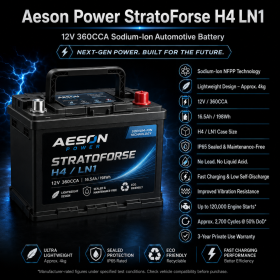
Aeson Power currently lists its sodium-ion automotive batteries at roughly 5–10 kg across much of the range and describes them as more than 60% lighter than typical 14–23 kg lead-acid batteries.
That is a meaningful reduction from a component that can usually be replaced without changing the vehicle's layout.
For performance-oriented cars, removing 10 kg or more from one component is useful. The benefit is particularly attractive because it does not require stripping interior trim, compromising comfort or relocating hardware.
The weight difference also makes the battery easier to handle during installation and replacement.
2. Can Sodium-Ion Really Crank an Engine?
Yes. A starter battery does not need to release all of its stored energy at once. What matters during cranking is whether it can maintain sufficient voltage while delivering a very large current for a few seconds.
A 2026 peer-reviewed study tested a 12V-class sodium-ion pack against a conventional lead-acid starter battery using repeated 200A, three-second discharge pulses. The researchers then installed the sodium-ion pack in a Škoda Fabia 1.4 MPI and recorded peak starting currents of around 140A.
The sodium-ion pack completed more than 20 consecutive real-world engine starts at approximately 15°C. Importantly, the test pack had only 14.3Ah nominal capacity compared with the vehicle's original 40Ah lead-acid battery.
That demonstrates an important point: high-current power capability matters more than headline Ah capacity during a normal engine start. A lower-Ah sodium-ion starter battery can still crank an engine effectively if it has been designed for high discharge current.
3. Why Amp-Hours Can Be Misleading
Battery shoppers often compare Ah figures first. That is useful when comparing two batteries of similar chemistry, but it becomes less reliable when comparing different chemistries.
An Ah rating measures charge capacity under defined test conditions. It does not directly tell you how well the battery can deliver a very high current over two or three seconds.
This is why a purpose-built sodium-ion starter battery can have lower nominal Ah capacity yet still provide excellent cranking performance.
When replacing a starter battery, compare the complete specification:
- case dimensions;
- terminal orientation;
- hold-down arrangement;
- cranking-current specification;
- charge-voltage range;
- usable reserve capacity;
- start-stop compatibility; and
- vehicle battery-management requirements.
4. Cycle Life: Where Sodium-Ion Becomes Very Interesting
Aeson Power publishes a cycle-life figure of more than 3,000 cycles for its sodium-ion automotive technology. Independent sodium-ion research also supports the broader premise that modern commercial sodium-ion cells can achieve long cycle life: recent peer-reviewed automotive-starter research cites commercially available cells exceeding 2,000 cycles.
Lead-acid cycle life is much more sensitive to depth of discharge. Sandia National Laboratories reports typical sealed lead-acid figures of around:
- 150–200 cycles at 100% depth of discharge;
- 400–500 cycles at 50% depth of discharge; and
- 1,000+ cycles at approximately 30% depth of discharge.
That does not mean every lead-acid starter battery will fail after a few hundred engine starts. Normal engine cranking uses only a small fraction of the battery's stored energy and the alternator quickly restores it.
What the comparison does show is that sodium-ion chemistry is particularly attractive where the battery experiences repeated cycling, start-stop operation or occasional deeper discharge.
5. Better Tolerance of Deep Discharge
Conventional starting lead-acid batteries are happiest when kept near full charge. Repeated deep discharge accelerates sulfation and other degradation mechanisms.
This is why a vehicle with an unresolved parasitic drain can destroy conventional starter batteries surprisingly quickly.
Aeson Power specifically promotes deeper-discharge tolerance as one of the strengths of its sodium-ion range and states that its batteries can discharge down to approximately 6V under abnormal over-discharge conditions while retaining better capacity recovery.
That is a useful resilience advantage, although a healthy vehicle should still keep any starter battery correctly charged.
6. Lower Self-Discharge During Storage
Aeson specifies a self-discharge rate of approximately 2–3% per month for its automotive sodium-ion batteries, compared with the 5–10% figure it cites for conventional lead-acid batteries.
Lower self-discharge is useful for enthusiast cars, secondary vehicles and cars that may sit unused for longer periods.
It does not eliminate parasitic vehicle loads. Alarm systems, keyless-entry modules, telematics equipment, trackers and other electronics may consume far more energy than the battery loses internally. A battery will still discharge if the vehicle itself is drawing current while parked.
7. Charging Compatibility Is the Most Important Fitment Question
A sodium-ion battery should only be used as an automotive replacement when the finished battery has been designed around automotive charging voltages.
This is particularly important because sodium-ion cell voltage varies by chemistry. An experimental pack assembled for research may have a different full-charge voltage from a commercial battery specifically engineered to replace a 12V lead-acid battery.
Aeson has designed its automotive range for vehicle starter use rather than selling generic energy-storage packs as car batteries. That distinction matters.
The practical rule is simple: use the charging specification of the exact automotive battery, not a generic sodium-ion voltage found online.
8. Modern European Cars and Battery Registration
Modern European vehicles often monitor battery current, voltage, temperature and state of charge. Some also vary alternator output according to vehicle load and energy-management strategy.
BMW, Audi, Volkswagen, Mercedes-Benz and other manufacturers use battery-management strategies on many newer models, particularly those fitted with AGM batteries and start-stop systems.
Replacing the battery may require registration, adaptation or coding so the vehicle knows a new battery has been fitted.
This is not unique to sodium-ion. The same issue already applies when replacing many conventional AGM batteries.
Where the vehicle requires registration or coding, it should be completed as part of the battery replacement procedure.
9. Cold-Weather Starting
Independent testing shows that sodium-ion can perform very strongly at moderate temperatures and even moderately below freezing.
In the 2026 starter-battery study, a fully charged sodium-ion pack achieved 31 successful 200A pulses at −5°C, compared with 24 from the lead-acid reference battery.
At −15°C, however, the particular experimental sodium-ion pack used in the study fell outside its useful high-current operating window and the lead-acid battery performed better.
This is useful context rather than a reason to dismiss the technology. Sodium-ion formulations vary considerably, and modern cell research is actively targeting wider operating-temperature ranges. For most Australian vehicles, −15°C engine starts are also far removed from normal operating conditions.
For Australia, hot-weather stability is usually more relevant than extreme Arctic starting performance.
10. Hot Climate Performance
Heat is one of the major enemies of conventional automotive batteries. Elevated temperatures accelerate corrosion and ageing reactions inside lead-acid batteries.
Aeson Power developed and markets its automotive sodium-ion batteries specifically for tropical conditions. Its current product information highlights high-temperature operation, stable electrical performance and integrated protection against overcharge, overheating and short circuit.
That makes the technology particularly relevant to Australian conditions, where ambient heat and under-bonnet temperature can be severe.
11. Safety: Different Chemistry, Different Risks
Lead-Acid
Lead-acid is a mature and well-understood technology. Its aqueous electrolyte is not flammable in the same way as the organic electrolyte used in many advanced rechargeable cells.
However, the battery contains corrosive sulfuric acid and toxic lead. Charging can also produce hydrogen, which is why battery venting and correct charging remain important.
Sodium-Ion
Sodium-ion automotive batteries eliminate sulfuric-acid leakage and avoid lead. Aeson promotes this as a major safety advantage of its range.
Modern sodium-ion cells can also be engineered with strong thermal stability and abuse tolerance. Recent peer-reviewed work continues to demonstrate sodium-ion designs aimed specifically at high safety, long cycle life and wide operating-temperature ranges.
As with any high-current automotive battery, correct pack engineering, protection and installation remain important.
12. What About Aeson's "Up to 5% Fuel Saving" Claim?
Aeson Power states that the combination of lower battery weight and stable electrical performance can deliver up to 5% lower fuel consumption.
The physical basis for part of that claim is straightforward: reducing vehicle weight reduces the energy required to accelerate and move the car. Replacing a battery weighing around 20 kg with one weighing 5–10 kg can remove a useful amount of mass.
The exact fuel saving will naturally vary between vehicles and driving conditions, so up to 5% should be understood as Aeson's published maximum rather than a fixed result that every vehicle will reproduce.
For a performance-car owner, the weight reduction itself is already a useful benefit even before considering any fuel-consumption change.
13. Does Sodium-Ion Replace AGM and EFB?
Potentially, but compatibility needs to be confirmed for the actual vehicle and battery.
AGM and EFB are highly developed lead-acid technologies designed for vehicles with demanding charging profiles and frequent start-stop cycling. They remain excellent products with universal workshop familiarity and a mature replacement market.
A purpose-built automotive sodium-ion battery offers a different route to the same job, with significant potential advantages in weight and cycling durability.
If the vehicle originally specifies AGM or EFB, confirm that the sodium-ion replacement is suitable for the vehicle's charging system, required cranking output and battery-management strategy before changing chemistry.
14. Recycling and Materials
Lead-acid has an enormous head start in recycling. The chemistry has been commercially dominant for decades, and lead, plastic cases and electrolyte are recovered through mature recycling systems.
Sodium-ion has different material advantages. Sodium is abundant, and sodium-ion cells can reduce dependence on lead and, depending on cell design, several of the more supply-constrained materials associated with other advanced batteries.
The sodium-ion recycling industry is much younger because commercial volumes are still far lower. As sodium-ion production grows, recycling and second-life processes are expected to develop alongside it.
So the environmental comparison is not one-sided: sodium-ion has attractive raw-material characteristics, while lead-acid currently has the more mature end-of-life recovery network.
15. Aeson Power's Published Automotive Figures
Aeson currently publishes the following headline figures for its automotive sodium-ion range:
- 3-year warranty for passenger vehicles under its Malaysian warranty program;
- more than 3,000 cycles;
- approximately 5–10 kg battery weight across much of the range;
- more than 60% lower weight than the typical lead-acid batteries used in its comparison;
- 2–3% self-discharge per month;
- deep-discharge capability to approximately 6V under abnormal conditions; and
- up to 5% fuel-consumption improvement.
Those are Aeson product claims rather than generic specifications for every sodium-ion battery. That is the correct way to read them: as features of the battery range Aeson has designed and tested for automotive use.
For Australian purchases, the product specifications and warranty terms published by Euro Car Upgrades for the exact battery are the relevant purchase information.
So, Is Sodium-Ion Better Than Lead-Acid?
For the right vehicle, sodium-ion has some very compelling advantages.
Choose sodium-ion for:
- major battery weight reduction;
- high cranking power from a compact battery;
- long cycle-life potential;
- better tolerance of deep discharge;
- low self-discharge during storage;
- maintenance-free operation; and
- an alternative to lead and sulfuric-acid battery chemistry.
Lead-acid remains strong for:
- low initial purchase cost;
- universal availability;
- very mature AGM and EFB technology;
- widespread workshop familiarity;
- proven compatibility with virtually every 12V vehicle platform; and
- established recycling infrastructure.
The interesting development is that sodium-ion no longer needs to be discussed as a hypothetical future replacement. Commercial automotive products now exist, and independent high-current testing demonstrates that the chemistry can perform the central job of a starter battery: delivering enough power to crank an engine repeatedly.
The deciding question is therefore straightforward:
Is there a sodium-ion automotive battery with the correct size, terminal layout, cranking performance and electrical compatibility for your vehicle?
If the answer is yes, it can be a genuine alternative to the conventional lead-acid battery rather than merely an experimental technology.
Frequently Asked Questions
Can a sodium-ion battery directly replace a lead-acid car battery?
Yes, where the sodium-ion battery has been designed specifically for automotive starter use and matches the vehicle's physical fitment, terminal layout, cranking requirements and charging system. Do not substitute a generic sodium-ion energy-storage pack.
Are sodium-ion car batteries lighter?
Yes. Weight is one of the clearest practical advantages. Aeson currently lists much of its automotive range at approximately 5–10 kg and compares this with typical lead-acid batteries weighing around 14–23 kg.
Can a lower-Ah sodium-ion battery still start the engine?
Yes. Engine cranking depends heavily on short-duration high-current capability. Independent testing has demonstrated repeated vehicle starts from a sodium-ion pack with significantly lower nominal Ah capacity than the original lead-acid battery.
Do sodium-ion automotive batteries last longer?
Sodium-ion chemistry has strong cycle-life potential. Aeson publishes a figure above 3,000 cycles, while peer-reviewed research reports commercial sodium-ion cells exceeding 2,000 cycles. Actual service life still depends on temperature, discharge depth, vehicle charging behaviour and use.
Are sodium-ion batteries better if the car sits unused?
They can be. Aeson specifies approximately 2–3% monthly self-discharge for its sodium-ion automotive batteries. Vehicle parasitic loads still consume energy while parked, so long-term storage should also take the vehicle's own electrical draw into account.
Do sodium-ion batteries work with normal car alternators?
Automotive sodium-ion batteries are designed for vehicle charging systems, but compatibility must be confirmed for the exact product and vehicle. Different sodium-ion cell chemistries have different voltage requirements, so only use a battery specifically designed as an automotive 12V replacement.
Do modern European cars need battery coding after replacement?
Some do. Battery registration or adaptation may be required so the vehicle's energy-management system recognises that a new battery has been installed. The procedure depends on the manufacturer and model and also applies to many conventional AGM battery replacements.
Are sodium-ion batteries suitable for hot Australian conditions?
Heat is an important consideration for any automotive battery. Aeson specifically developed its current automotive range for tropical operation and promotes high-temperature performance as one of the advantages of the product family.
Is the 5% fuel saving guaranteed?
Aeson specifies fuel savings of up to 5%. The actual change will depend on the vehicle, battery weight difference, driving cycle and operating conditions, so the figure should be treated as a potential maximum rather than a fixed result.
Is sodium-ion better than AGM?
It depends on the application. Sodium-ion can offer a major weight and cycle-life advantage, while AGM remains extremely mature, widely available and designed around established smart-charging and start-stop systems. Vehicle compatibility should decide the replacement rather than chemistry alone.
Explore Sodium-Ion Automotive Batteries
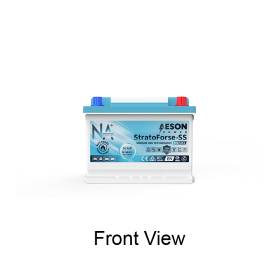
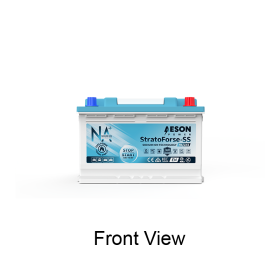
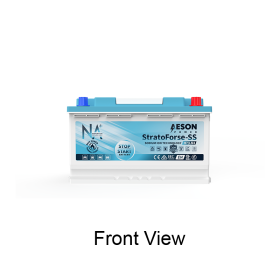
Euro Car Upgrades offers selected Aeson Power sodium-ion starter batteries for compatible vehicles. Check the exact battery dimensions, terminals, cranking output and vehicle requirements before ordering.